
Day of the Dead
The path of souls
The path of souls is the popular Day of the Dead calendar that tells which of the departed arrive at the offering each day, from October 27 to November 2. Each date is dedicated to a different group: animals, those who died tragically, the drowned, forgotten souls, children and, finally, all of our dead.
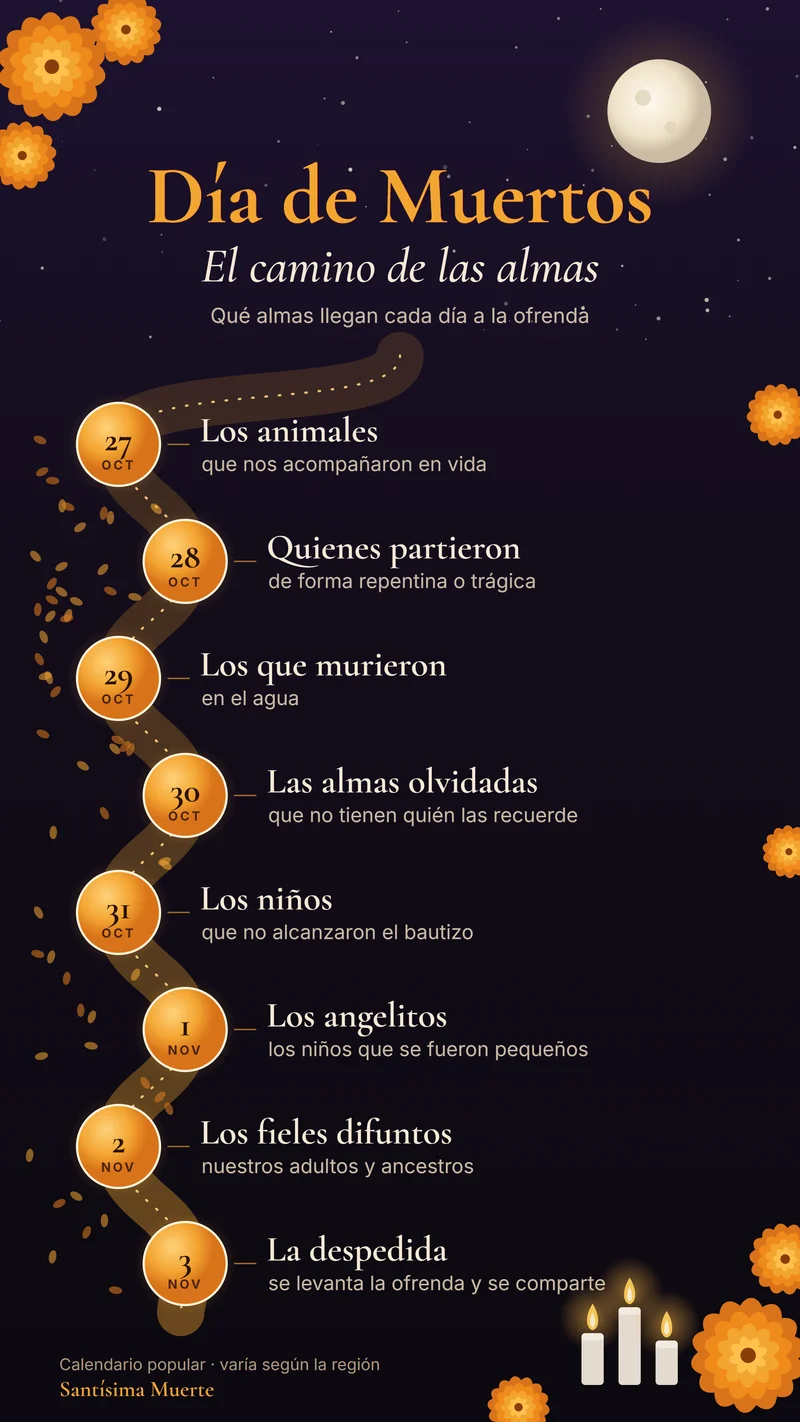
The path of souls, day by day
The dates change from one town to another, and every family has its own customs. This is the version most often repeated in Mexico:
October 27: the animals who kept us company
This is the newest custom in the calendar, and it has spread widely in recent years. People remember the dogs, cats and other animals that were part of the family. On the offering they place the animal's photo, a bowl of water, some of its food and sometimes its favorite toy.
October 28: those who left suddenly
This day is dedicated to those who died in accidents or in a violent or tragic way: people who had no time to say goodbye. They are welcomed with a candle and white flowers. In some places their offering is placed outside the house.
October 29: those who died in the water
People remember the drowned and those who lost their lives in rivers, lakes or the sea. Besides the candle, a glass or jug of clean water must not be missing.
October 30: the forgotten souls
It is a day of charity. A candle is lit and a little bread and water are left for the souls who have no one waiting for them: those who died alone, without family or far from home. No one should arrive at an empty table.
October 31: the children who were never baptized
It is dedicated to babies who died before birth or without being baptized. They are welcomed with white flowers, a candle and sometimes a little milk.
November 1: the little angels
The children who died young arrive; they are lovingly called "angelitos", little angels. Their offering is joyful: candy, toys, fruit, milk, bread and colorful flowers. This day coincides with All Saints' Day in the Catholic calendar.
November 2: the faithful departed
This is the big day. The adults arrive: parents, grandparents, siblings, friends. The offering fills with their favorite food and drink, their photo, pan de muerto, salt, copal and candles. A path of marigold petals, from the door to the altar, shows them the way. That is where the name "path of souls" comes from.
November 3: the farewell
In many families, when the visit of the dead is over, the offering is taken down. The food is shared with family and neighbors, and thanks are given to those who came. It is said that the departed have already taken the essence of the food.
Why the dates are not the same everywhere
The path of souls is not an official calendar. It is a popular tradition passed down in families, and it changes by region. In some places October 30 is for unbaptized children and October 31 for forgotten souls; in others, the 28th and 29th are merged into a single day. The day for animals is a new custom that not everyone follows. No version is the "correct" one: what matters is the intention to remember.
A journey that comes from long ago
The idea that souls travel a path is very old in Mexico. The Mexica believed that those who died a natural death traveled for four years through nine regions of the underworld, helped by a dog, until they reached the lords of death. You can read that story on the page about Mictlantecuhtli and Mictecacíhuatl.
With the arrival of Catholicism, that journey merged with All Saints' Day and All Souls' Day. The result is the Day of the Dead we know: a celebration in which the dead do not leave forever, but come back once a year to visit their loved ones.
The path of souls and Santa Muerte
The Day of the Dead and Santa Muerte are not the same: the first is a tradition for remembering the departed and the second is a devotion. But for her devotees they are closely linked. November 1 is Santa Muerte's most important date, and many place a candle for her on the offering to ask her to guide and watch over their departed on the way.
If you want to accompany these days with a prayer, pray the Santa Muerte novena or learn about the origin of the devotion.