
Mexica roots
Mictlantecuhtli and Mictecacíhuatl
Mictlantecuhtli and Mictecacíhuatl were the lords of Mictlán, the Mexica (Aztec) place of the dead. Together they ruled the last and deepest of its nine levels, guarded the bones of the departed and welcomed those who arrived at the end of a four-year journey. Many Santa Muerte devotees regard them as her oldest ancestors.
Who Mictlantecuhtli and Mictecacíhuatl were
Mictlantecuhtli means "lord of the place of the dead" in Nahuatl. He was shown as a skeleton, or as a body with a skull face and bared teeth, decorated with paper and wearing bone ear ornaments. Creatures of the night went with him: the owl, the bat and the spider. Other peoples, such as the Zapotec and the Mixtec, also worshipped him under other names.
Mictecacíhuatl, "lady of the dead", was his wife and companion. She was said to watch over the bones of the dead and to preside over the festivals the Mexica dedicated to their departed. Some sources also call her Chalmecacíhuatl. The chronicles sometimes show her working alongside her husband and sometimes disagreeing with him: she was not a minor figure, but the other half of the realm of death.
Mictlán: the place of the dead
For the Mexica, your fate after death did not depend on how you had lived, but on how you had died. According to what Friar Bernardino de Sahagún recorded in the 16th century:
- To Mictlán went those who died a natural death or of ordinary illness, whether lords or commoners, regardless of rank or wealth.
- To the house of the Sun went warriors who died in battle or in sacrifice, and women who died in childbirth, who were also considered warriors.
- To Tlalocan, the paradise of the rain god, went the drowned, those killed by lightning and those who died of illnesses linked to water.
- To Chichihualcuauhco went small children, who were fed by a tree whose branches gave milk.
Mictlán lay to the north, the direction of cold and darkness. Getting there was not immediate: the dead had to travel a road full of trials that, according to the chronicles, took four years.
The journey through the nine levels
The road to Mictlantecuhtli and Mictecacíhuatl crossed nine regions. The names vary by source, but the most frequently cited route is this:
- Itzcuintlan, "place of the dogs". A wide river had to be crossed, and it could only be done with the help of a dog.
- Tepetl Monamicyan, "where the mountains meet". Two mountains crashed into each other and you had to pass between them.
- Itztepetl, "obsidian mountain". A mountain covered in sharp flints.
- Itzehecayan, "place of the obsidian wind". An icy wind that cut like a blade; here the dead lost their clothes and belongings.
- Pancuetlacaloyan, "where people flutter like flags". A weightless place where bodies floated at the mercy of the wind.
- Temiminaloyan, "where arrows rain down". Arrows shot by invisible hands.
- Teyollocualoyan, "where hearts are eaten". Wild beasts that devoured the hearts of the dead.
- Apanohualoyan, "where the water is crossed". Black waters that had to be crossed.
- Chiconahuamictlan, "the ninth place of the dead". The end of the road, where Mictlantecuhtli and Mictecacíhuatl waited and the soul finally rested.
The dog that guides the dead
To cross the first river, the dead needed a dog. Sahagún writes that the dead were buried with a "little reddish dog", with a loose cotton thread around its neck, so that it would wait for them on the riverbank and swim them across. That is why the xoloitzcuintle, Mexico's hairless dog, is still associated with the journey of souls and appears today on altars and offerings.
The myth of the bones: how death gave life to humans
One of the most beautiful stories about Mictlantecuhtli is found in the Legend of the Suns, a 16th-century Nahuatl text. It tells that when the gods wanted to create a new humanity, the god Quetzalcóatl went down to Mictlán to ask for the bones of the people who had lived before.
Mictlantecuhtli agreed, but on one condition: Quetzalcóatl had to blow a conch shell that had no holes. Quetzalcóatl called the worms, which drilled it, and the bees, which went inside and made it sound. The lord of the dead was forced to hand over the bones, but then tried to get them back and had a pit dug in his path. Some quails startled Quetzalcóatl, who fell and dropped the bones, which broke into pieces of different sizes; that is why, the myth says, people are of different heights.
Quetzalcóatl gathered the bones and took them to Tamoanchan. There the goddess Cihuacóatl ground them, and the gods poured their own blood over them. From that mixture human beings were born. For the Mexica, then, humanity was born from the bones kept by the lord of death: life and death came from the same place.
The festivals of the dead
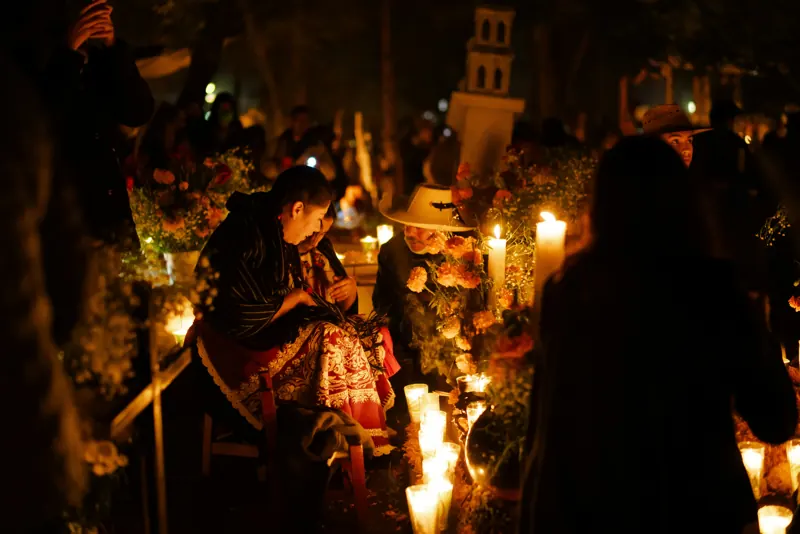
The Mexica dedicated two months of their solar calendar to the dead. Chroniclers such as Friar Diego Durán called them Miccailhuitontli, "the little feast of the dead", dedicated to children, and Hueymiccailhuitl, "the great feast of the dead", dedicated to adults. They fell roughly between August and September, and Mictecacíhuatl presided over these celebrations.
With the arrival of the Spanish, these festivals gradually merged with All Saints' Day and All Souls' Day, on November 1 and 2. From that blend the Day of the Dead as we know it today was born.
What archaeologists found
In the Templo Mayor precinct of Tenochtitlan, in the center of Mexico City, archaeologists found in the 1990s, in the so-called House of the Eagles, two life-size clay sculptures of Mictlantecuhtli. They show him with a fleshless body, his liver hanging below his ribs and hands like claws. Today they are on display at the Templo Mayor Museum and are among the most striking works of Mexica art.
His worship also had a harsh side worth knowing: the chronicles report that human sacrifices were made in his honor, as in the worship of other Mexica gods.
Are they Santa Muerte's ancestors?
Many devotees see Mictecacíhuatl as Santa Muerte's grandmother: a lady of the dead, venerated in Mexico long before the Conquest, who did not disappear but changed her face. After 1521, the European image of Death, a skeleton with a scythe, blended with the memory of these gods.
Researchers are more cautious. Authors such as Claudio Lomnitz and Katia Perdigón Castañeda point out that there are no documents proving a direct line between the worship of Mictecacíhuatl and today's devotion. What is clear is that in Mexico death was never only something to fear: since the Mexica, it has been honored, given offerings and spoken to.
If you want to follow the thread to the present day, read the history of Santa Muerte from New Spain to the Tepito altar, or discover why death is love for her devotees.